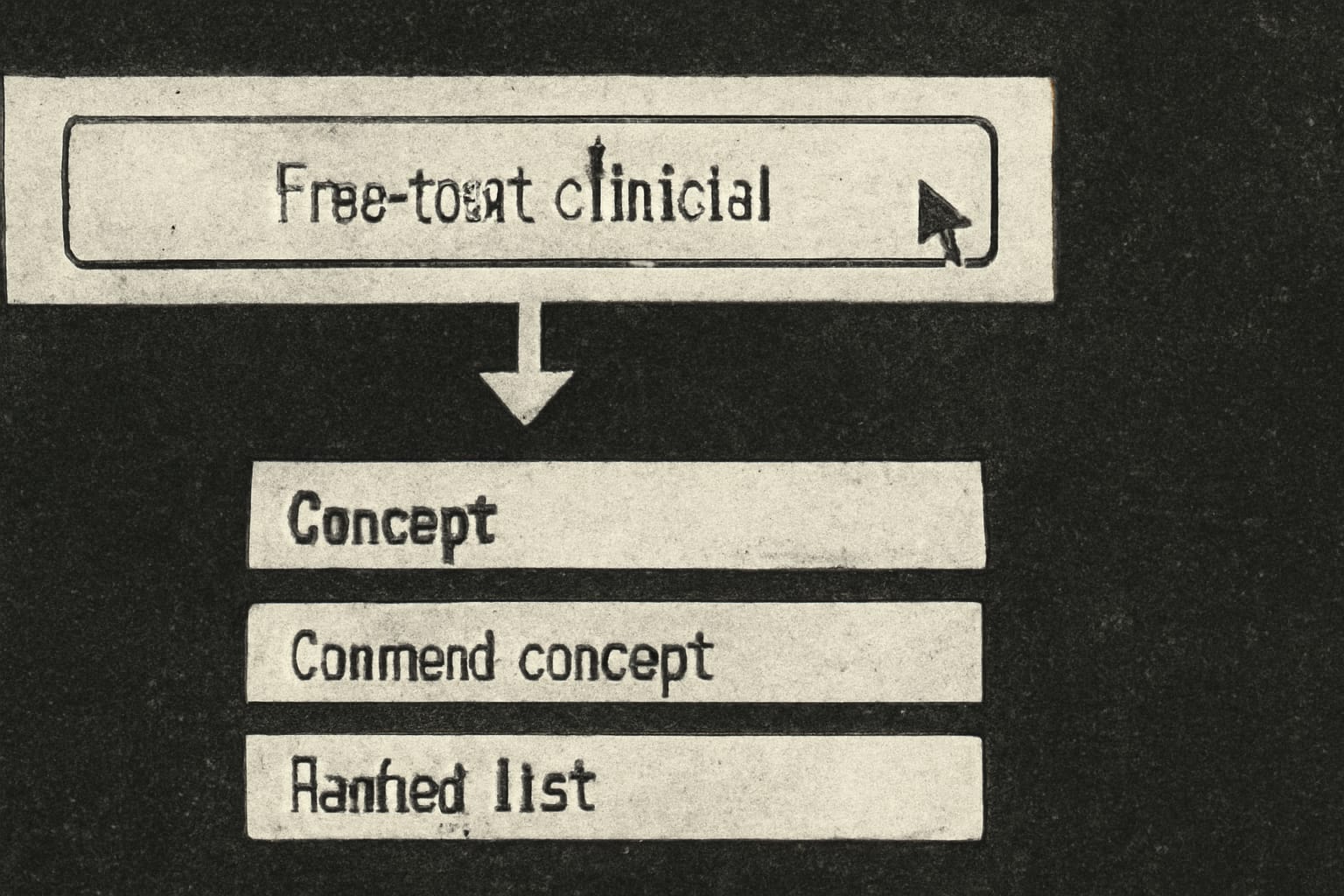
What do you do when the intake form gives you "sharp pain around the belly button that goes to the right side" and the downstream system expects a SNOMED CT concept ID? The distance between the way clinicians describe a symptom and the way SNOMED encodes it is where most SNOMED integrations quietly bleed accuracy. Getting from free text to a defensible concept is a small discipline that pays back on every future review.
The site's SNOMED CT common-concepts browser covers the most common Clinical finding and Situation concepts the field actually reaches for. For the surrounding FHIR context, the FHIR explainer collection has related walkthroughs.
Start With a Synonym Sweep, Not a Free-Text Guess
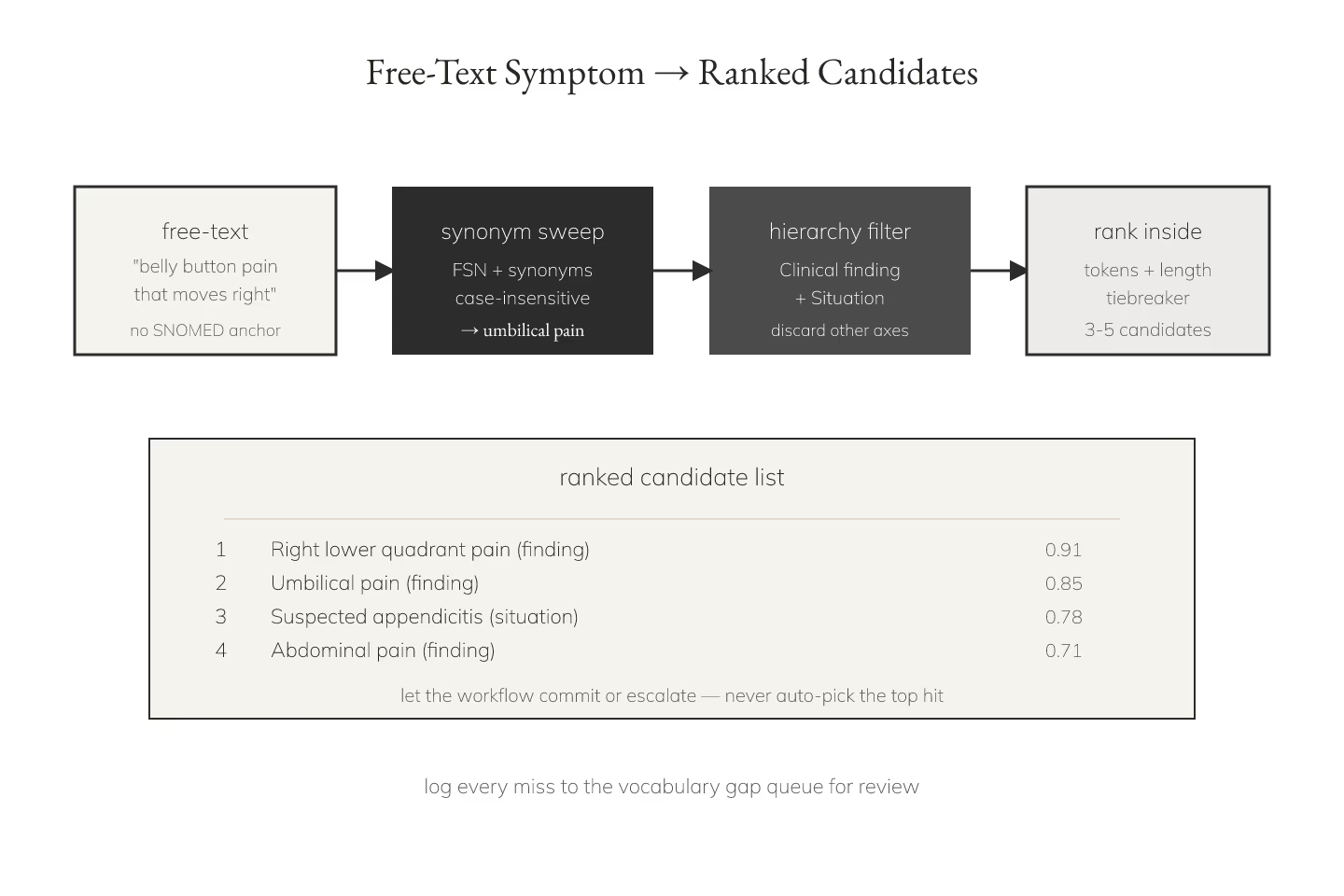
SNOMED CT concepts carry more than one description each: a fully specified name, a preferred term, and a large set of synonyms. Skipping the synonym index is the first mistake. A search for "belly button pain" fails against the FSN but hits synonym rows for umbilical pain immediately.
Search order that works in practice:
- Full description index (synonyms + preferred terms), case-insensitive
- Substring match against fully specified names
- Fuzzy match with a small edit distance for typos
- Fallback to related-concept traversal only when the above fail
Skipping straight to fuzzy is expensive and noisy. The synonym index gets you home fast in most cases.
Rank by Concept Type Before Ranking by Score
A free-text symptom almost always resolves to a Clinical finding or a Situation with explicit context. Ranking has to know that before it starts. A raw description match that returns a Body structure or a Substance concept for a symptom query is not "close" — it is wrong for the shape the caller expected.
Filter by the SNOMED top-level hierarchy first, then rank inside it. The hierarchies that matter for symptom search are Clinical finding, Situation with explicit context, Observable entity, and occasionally Procedure when the phrase is procedural. Everything else is noise for this query type.
Use the Description Length as a Weak Precision Signal
Short SNOMED descriptions tend to be more specific concepts; long descriptions tend to be broader groupings. That is not a rule of the standard, but it is a strong empirical pattern worth using as a tiebreaker. When two candidates match the query equally on tokens, prefer the shorter description in the same hierarchy.
That tiebreaker fails on post-coordinated expressions and on some anatomy concepts. Do not use it as a primary ranker.
Return Multiple Candidates, Never Just One
The temptation is to bind free text to the top hit. Resist it. A SNOMED search for a symptom should return a small ranked list, three to five candidates, and let the calling workflow either commit or escalate to a coder. Committing to a single concept from a fuzzy query is how the wrong problem list gets built. In practice you also learn a lot from watching which of your top three the human actually picks.
For teams that want a deeper picture of how to use concept relationships to widen or tighten a match, concept relationships as a search-quality lever covers that lever specifically.
Log the Miss Cases, Do Not Just Fall Through
Every unmatched free-text symptom is a signal. Either the vocabulary needs a synonym extension for your region, the caller is speaking a non-clinical register, or the caller is on the wrong SNOMED edition. Logging the miss lets you decide which. Silent fallbacks turn small vocabulary gaps into large data-quality problems six months later.
Language and edition matter here too. A GB or AU edition holds synonyms that the International Edition does not, and calls that hit the international only miss those. For the deeper picture, language and edition considerations in SNOMED lookups covers the split.
The Short Version
Free-text symptoms fail SNOMED lookups quietly. Sweep the synonym index first, filter by hierarchy, rank inside it, keep a small candidate list, and log the misses. That is the difference between a search that helps clinicians and one that burdens them. For the interactive latency side of it, SNOMED lookup performance patterns for interactive UIs is where to look next.
Sources
- SNOMED International Confluence canonical documentation for - SNOMED International Confluence canonical documentation for SNOMED CT search, evergreen reference