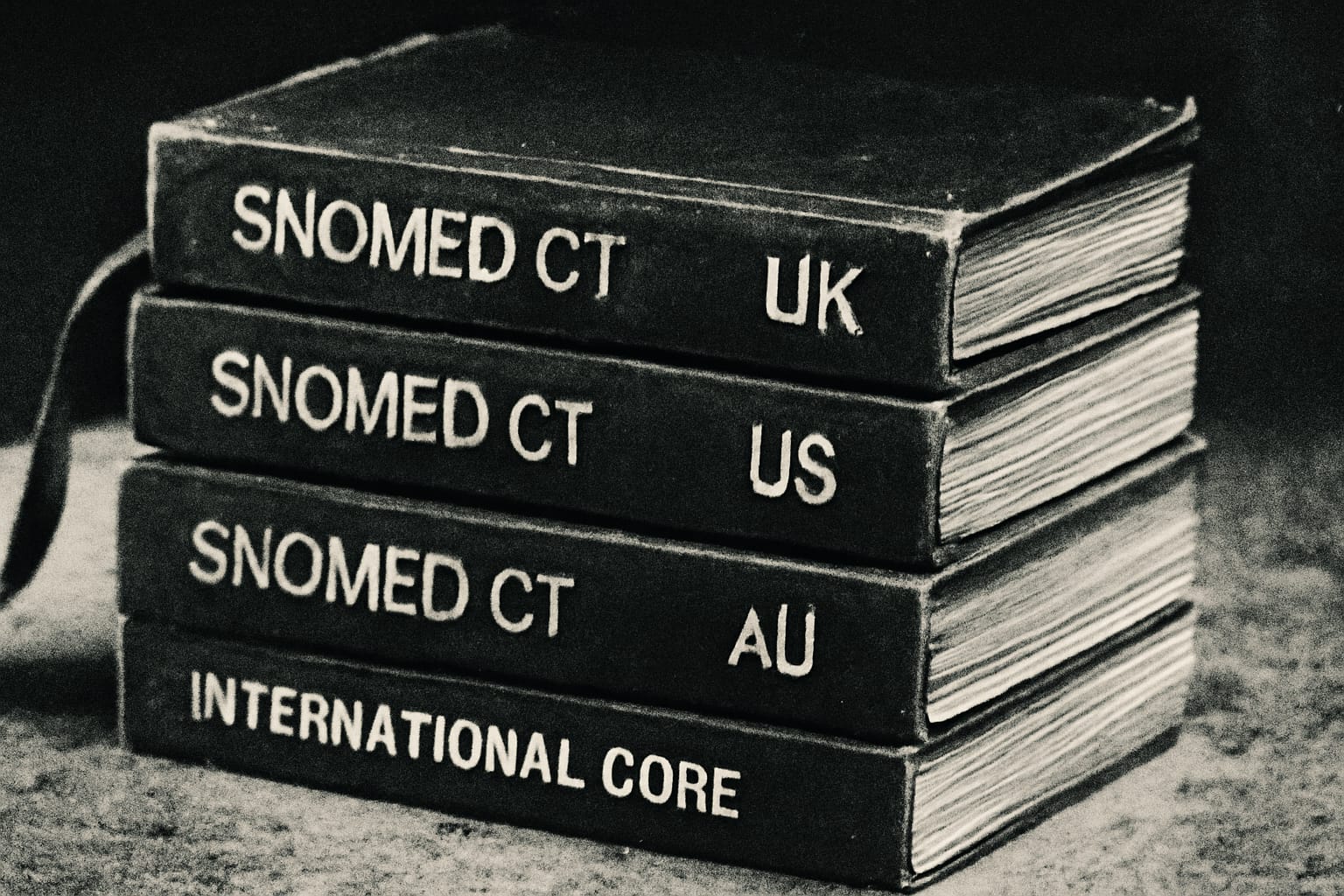
A SNOMED search that runs against the international edition and then gets deployed to a UK, US, or AU clinic quietly under-performs. Not because the concepts are missing, but because the descriptions, synonyms, and preferred terms are different by edition. Language and edition are the two dimensions most projects treat as constants when they are anything but.
The site's SNOMED CT common-concepts browser picks concepts that survive across editions. For the broader terminology setting, more healthcare interoperability notes collects related pieces.
Concepts Are Global, Descriptions Are Not
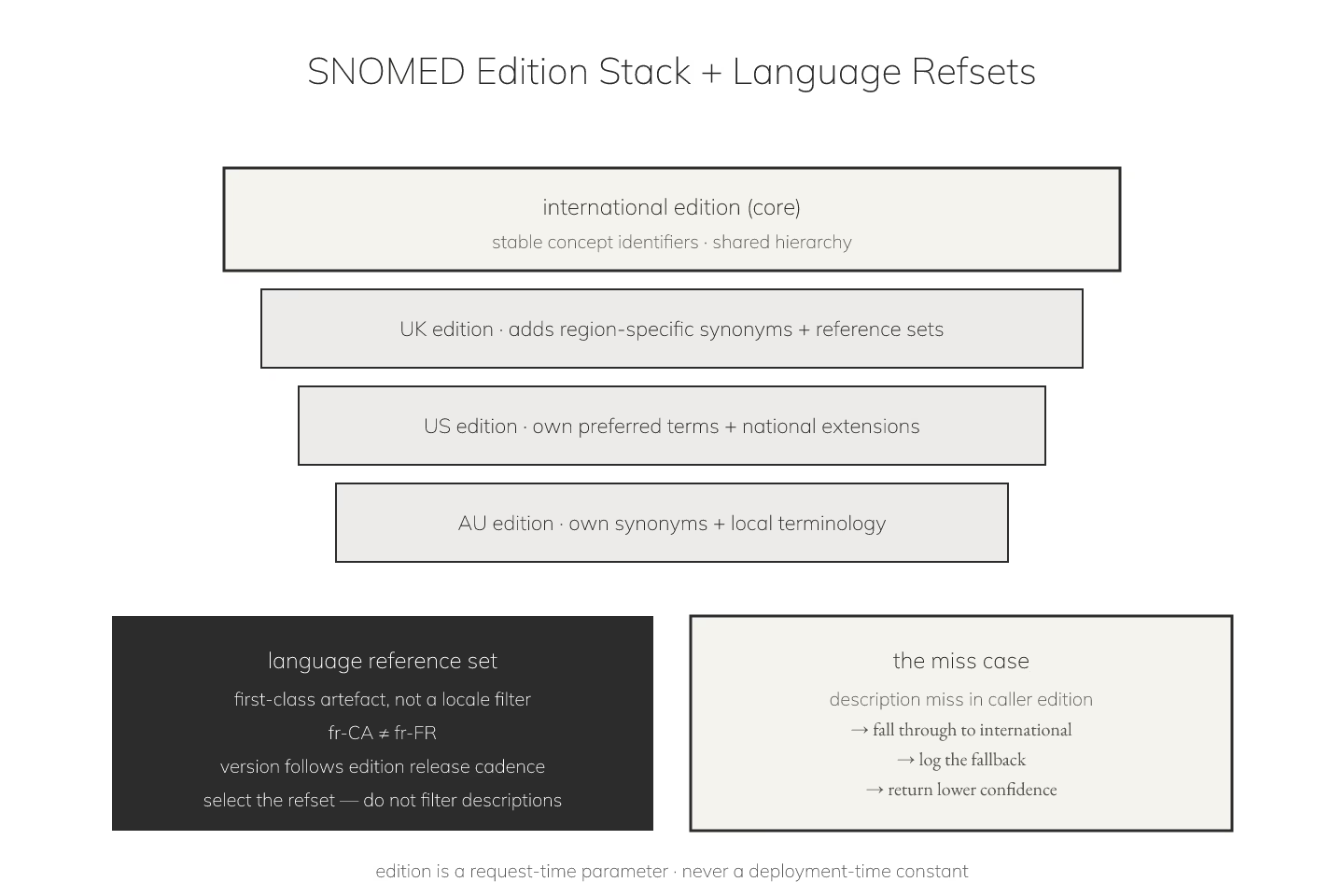
The concept identifier is stable across editions. The description content is not. The UK edition has synonyms that the international edition does not. The US edition has different preferred terms in a small but meaningful set of cases. The Spanish edition adds description content in Spanish. Every synonym-based search inherits those differences.
If your search hits descriptions and your edition is not the caller's edition, expect a real miss rate.
Pick The Edition At The Request Level, Not The Deployment Level
Hardcoding an edition into the search service is the pattern that breaks first when the product expands to a new region. The edition should be a request parameter, defaulted from the caller's context, and the search service should hold multiple editions simultaneously. Editions are additive over the international core, so this is less painful in storage than it sounds.
For teams that also curate reference sets for domain scope, editions and reference sets multiply. Each reference set has to be validated per edition or explicitly declared edition-agnostic. Reference sets: the SNOMED feature that shrinks your problem covers reference-set fundamentals.
Language Is Not Just Locale
SNOMED descriptions are indexed by a language reference set, and the language reference set is a first-class artefact. Serving a French-Canadian caller means selecting the French-Canadian language reference set, not just filtering by an ISO language code on the description row. Two different French regions can prefer different terms for the same concept. Skipping the language reference set gives them the same result and pretends the difference does not exist.
Update On The SNOMED Release Cadence, Not Yours
SNOMED CT releases twice a year for the international edition, and national editions follow their own schedules. Your search index should follow those cadences. A stale edition manifests as concepts that got renamed, retired, or split behaving unpredictably. Set the refresh as an automated job, not as a human task that someone eventually remembers.
What Happens On A Miss
A description miss when the concept exists in another edition is a specific and recoverable case. Fall through the caller's edition to the international edition, log the miss, and surface it to the caller as a lower-confidence match. Do not silently swap editions and return the international hit as if it were the caller's edition — that hides the mismatch.
For the broader receiver-side handling of concepts that are ambiguous or partial, handling ambiguous SNOMED concepts in a downstream system covers what to do with those signals.
The Short Version
Edition and language are request-time parameters. Treat them as such. Hold multiple editions in the search service, follow the SNOMED release cadence, and use language reference sets rather than raw locale filters. For the search-entry side of it, searching SNOMED CT when you only have a free-text symptom covers how the whole flow starts.
Sources
- SNOMED International guidance on national editions and - SNOMED International guidance on national editions and extensions