SNOMED CT has around three hundred fifty thousand active concepts. Almost every real-world integration needs a few hundred of them. The gap between those two numbers is where most SNOMED problems live, and reference sets are the vocabulary's own answer to that gap. Once a team understands them, the rest of the terminology stack gets simpler.
The site's SNOMED CT common-concepts browser is itself effectively a reference set. For the broader landscape, additional FHIR walkthroughs collects related pieces.
What A Reference Set Actually Is
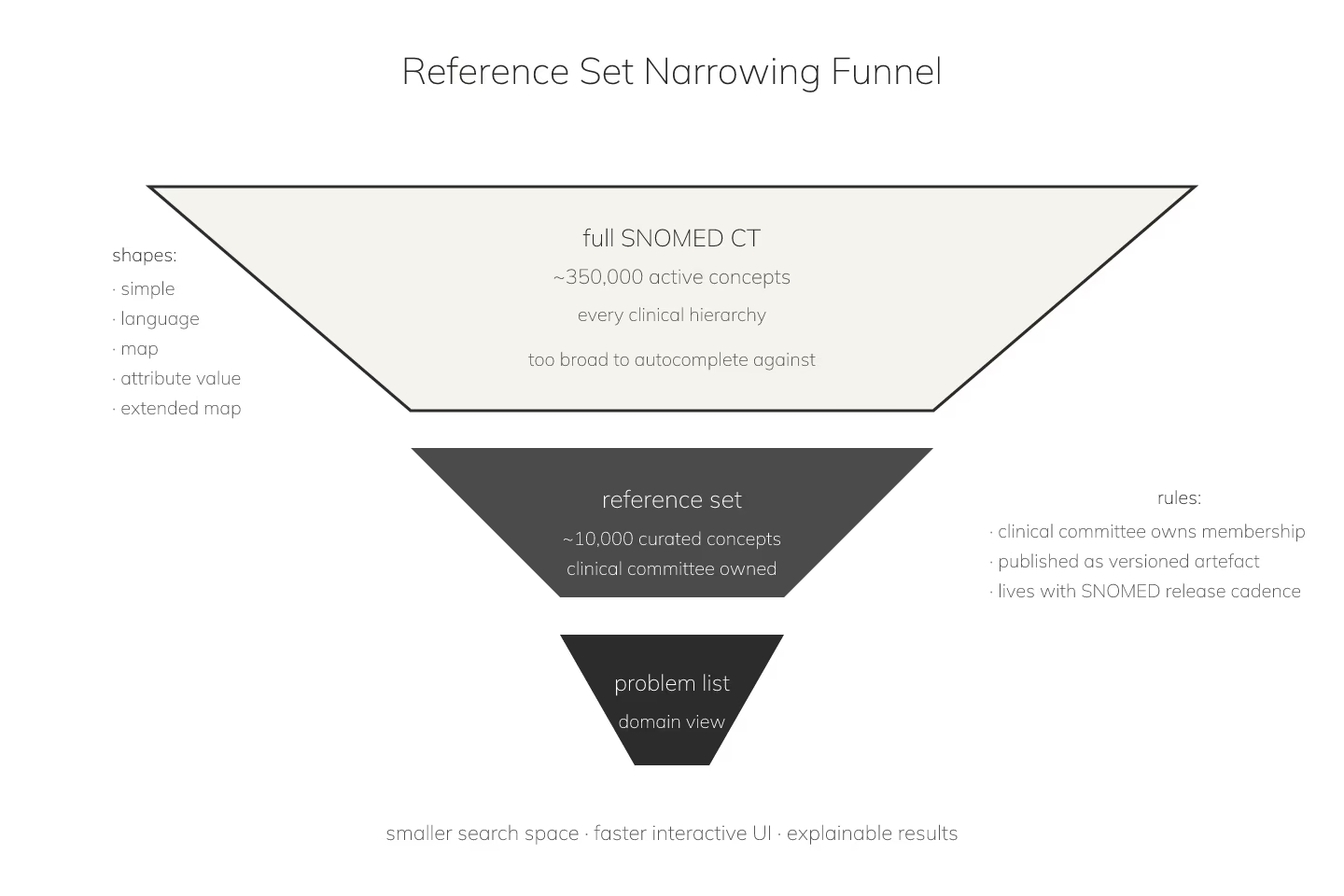
A reference set is a curated collection of SNOMED CT components, published on the same release cadence as the terminology itself. The most common shapes are:
- Simple reference sets — a flat list of concepts for a domain
- Language reference sets — mapping preferred terms to a locale
- Map reference sets — linking SNOMED to another vocabulary such as ICD-10
- Attribute value reference sets — constraining which values a given attribute can take
- Extended maps — richer mappings with rules and priorities
Each one is a first-class artefact in SNOMED. It is versioned, published, and machine-readable. That is the reason to prefer it over hand-rolled lists in code.
When The Search Space Is Too Large
The most common use case is boring and load-bearing. Rather than searching all of SNOMED for a problem-list entry, search a reference set of ten thousand curated concepts that a clinical committee has already agreed on. The search becomes fast, the results become explainable, and the concept space stops drifting between releases.
If your team is talking about "curated lists in a spreadsheet," you are already building a reference set poorly. Publish it properly and reuse it across services.
When The Map Is Load-Bearing
Any SNOMED-to-ICD-10 pipeline is a map reference set problem. Trying to hand-maintain the mapping is expensive and drift-prone. The published map reference sets are not perfect, and jurisdictional adjustments are common, but they are a much better starting point than a spreadsheet or a database of hand-picked links. For the underlying question of which vocabulary to use in which field, SNOMED CT vs ICD-10: when each one is the right answer covers the split.
Building Your Own Reference Set
Two rules keep local reference sets healthy:
- Membership decisions are made by a clinical committee, not by an engineer
- The reference set is published as an artefact with a version and an owner
If either rule breaks, the set drifts from what the field actually uses within six months. A refset that is a maintained artefact stays useful; a refset that is a static file in a repo does not.
Reference Sets And Performance
An interactive UI that hits a reference set instead of the full terminology can serve most searches from memory. Ten thousand concepts fit comfortably in a hot cache; three hundred fifty thousand do not. That single decision often decides whether the SNOMED search feels instant or laggy. For the interactive performance side, SNOMED lookup performance patterns for interactive UIs covers the pattern in depth.
When Reference Sets Do Not Solve The Problem
Reference sets flatten the search space but they do not add clinical relationships. Widening a match to include a specific child concept, or tightening it to exclude a sibling, still requires walking the SNOMED hierarchy. For that side of it, concept relationships as a search-quality lever is the entry point.
The Short Version
Reference sets are the SNOMED feature most teams underuse. Adopt them for domain-scoped search, adopt them for maps, and treat local ones as versioned artefacts owned by a clinical committee. The vocabulary becomes tractable, and the terminology layer stops being the reason the UI feels slow.
Sources
- SNOMED International Release File Format canonical - SNOMED International Release File Format canonical Reference Set specification